I spent the weekend of the 100th anniversary of the sinking of the Titanic in a global missions conference in California. I couldn’t help but notice the glaring similarities between the Titanic and our lost world.
Having never encountered a storm at sea the Titanic has become one of the most famous ships in history. Stories concerning this passenger liner have been told time after time throughout the past one hundred years yet it remains fascinating. Although the builders never officially acclaimed this massive triumph over other forces of nature to be unsinkable, it was certainly widely speculated to be so.
After the iceberg disappeared the ship remained afloat for over two hours. At first it was believed the boat was only slightly damaged rather than doomed. The parties on the ship continued as if nothing was going on; no imminent danger was in sight. Isn’t that like our world? They are having a big party never noticing that Jesus is coming soon.
One thing that amazes me is the lifeboats on board. They would have serviced barely one-third of the passengers and crew. It was understood that a ship having all the safety features of the Titanic would sink so slowly that there would be lots of time to spare. Each AIMer and missionary is a lifeboat destined to rescue lost humanity. I fear, at times, that we simply don’t have enough lifeboats on hand. However, God continues to bless and use all that make themselves available. If the Titanic had enough lifeboats all could have been saved since it took 2.5 hours to sink. Thank God you have stepped forth to be involved in global missions providing a lifeboat in your area of the world.
Only two lifeboats rescued others after being launched. I trust the church will never have the same testimony. We’ve been rescued—to rescue others. We cannot be at ease on the lifeboat. There is much work to be done.
The first lifeboats leaving the ship were far from full. J. B. Thayer, a survivor said, “Partly filled lifeboat about 100 yards away never came back….How could any human being fail to heed those cries.” I wonder at that myself. With over seven billion people in our world we need to salvage as many as possible as quickly as possible.
People from all walks of life boarded the Titanic in April 1912. There were millionaires, celebrities, middle income earners, and even poor people. A few hours after the disaster, there were only two categories: lost and saved. In the end, it all comes down to that: lost or found. Those are a few tiny, timeless thoughts on the Titanic.
“Before I formed you in the womb I knew you; Before you were born I sanctified you; I ordained you a prophet to the nations” (Jeremiah 1:5, NKJV).
“For I know the thoughts that I think toward you, says the Lord, thoughts of peace and not of evil, to give you a future and a hope” (Jeremiah 29:11, NKJV).
Ever dropped something made of glass? Come on. In all truthfulness pretty much everyone has the typical glass breaking trauma story. Mine may or may not have something to do with the Rodenbush’s butter dish…or I guess I should say, former butter dish. The bad thing about glass breaking is that you can’t put it back the way it was. After you have shattered something on the kitchen floor, it isn’t exactly possible to simply put it back together. Once broken, there is no going back.
Photo by Buzz Hoffman
Ever felt much like that broken glass? Lying on the floor, shattered in dozens of pieces. Unfixable. Permanently damaged. Past the point of hope. Perhaps you now feel as though you are broken into hundreds of tiny pieces and you will never be put back together into one whole piece again. The situation is a Mission Impossible; a dying cause. Or so you think. What if all your concepts are wrong? You see, for the most part, the breaking of glass is always viewed as a bad thing, when in reality it can be very good.
In the Middle Ages, a new art form became popular and has carried through even till today—the fine art of the stained glass window. I don’t know how much you know about stained glass windows, but I Googled them and everything, so I am now quite the expert. For all of you less informed in the art, stained glass windows start out as panes of glass that must be broken into pieces. Actually, more specifically, they aren’t broken at all, but rather, cut to fit a specific design. The glass isn’t stained, but painted in great detail by the master’s hand.
“For I know the thoughts that I have towards you, saith the Lord, thoughts of peace, and not of evil, to give you an expected end.” Before you were formed in your mother’s womb, God had a specific plan for you. The blueprint is already made; the end of your story written. Now, here is the thing. What if all the things we have been through, all the trials, heartbreaks, failures, and disappointments, what if all the things that left you broken, what if they didn’t leave you broken at all? Perhaps, it was the Lord cutting, shaping, and molding you to fit his master plan. What if the things that you thought left you broken, useless, and stained, were actually the Lord shaping and cutting you into the masterpiece He always intended you to be?
Romans 8: 28-30 says, “And we know that all things work together for good to them that love God, to them who are called according to his purpose. For whom he did foreknow, he also did predestinate to be conformed to the image of his Son, that he might be the firstborn amongst many brethren. Moreover whom he did predestinate, them he also called: and who he called, them he has also justified: and whom he justified, them he also glorified.”
First of all, “all things work together for good to them that love God.” I think a lot of the time we can interpret that incorrectly. It does not say that everything will always be good, that we won’t have problems, or pain, or suffering. It says that if we love God and are called, He will take all of those things and use them for your good.
Secondly, “to them who are called according to His purpose.” How many of you feel like God has placed a calling on your life? Ever feel like you have been called and things have gone on, and mistakes have been made, and you feel disqualified a bit from your calling? Well, that isn’t what my Bible says. My Bible says that as long as you love the Lord and are called, He had a plan for you before you were even born. He already knew the end of you story as well as the beginning and middle. And He justified your past. Therefore, he knew long before you were born how things were going to turn out and He has already taken care of it.
The last component of a stained glass window is the glue or mortar that puts all the pieces back. It comes along and fills in all the cracks. It is the finishing; the thing that holds our world together. Our strength when we are weak, our comfort when we are weary, our help in time of, He is the Alpha and Omega, the beginning and the end. He is Daystar, Prince of Peace, Everlasting Wonder, Great I am, and Counselor. His name is Jesus; the glue that completes the puzzle of His master plan for your life. Without the last component, you can do nothing. If you step out His will and purpose, you become nothing more than little broken pieces of glass. His master plan for your life has to contain both you and Him. Without both, the plan cannot succeed.
The pain may be great, though the process may not be pleasant, but if you will just submit yourself to His master plan and allow Him to be the glue that hold your world together, the end result may just stun the world with its beauty. And don’t you find it interesting that the most intricate stained glass windows are the ones that must be broken/cut the most? Surrender to His plan, follow His will, stick to Jesus in the process, and know that the end result is going to be simply beautiful. Allow Jesus to fill in the cracks of your life and shape you into His masterpiece.
“Then saith he unto his disciples, The harvest truly is plenteous, but the labourers are few” (Matthew 9:37).
We’ve heard that dozens of times. The harvest is plenteous. The laborers are few. Contained in those words is a gigantic opportunity: the big harvest. The problem is He needs workers. Because there are lots of lost and only a few seekers a strategy for world evangelism is paramount. Therefore, here is what you do:
Image by humberpike via Flickr
Call:
“And when he had called unto him his twelve disciples, he gave them power against unclean spirits, to cast them out, and to heal all manner of sickness and all manner of disease” (Matthew 10:1). Because there are lots of lost and only a few seekers, God calls. Entire lessons and books have been written on the subject of the call so we won’t linger with that. The thing to note here is to reiterate that for those He calls, He gives them power. He enables, equips, and empowers His workers to reap the harvest. A call birthed in prayer and fasting, releases spiritual authority and power.
Go:
“These twelve Jesus sent forth, and commanded them, saying, Go not into the way of the Gentiles, and into any city of the Samaritans enter ye not: But go rather to the lost sheep of the house of Israel. And as ye go, preach, saying, The kingdom of heaven is at hand” (Matthew 10:5-7).
The obvious thing about being sent forth is that someone has to “go.” Jesus carefully directed them to the lost. They were to start with the “lost sheep of the house of Israel.” His plan for evangelism started at home but eventually worked its way around the globe (Acts 1:8). They began in their Jerusalem but didn’t stop there. It is always God’s plan to go the distance; to the uttermost parts of the earth. Someone has rightly said that the light that shines the furthest shines the brightest at home. Some else quipped, “Don’t send a lamp to the mission field that will not burn at home.”
In reading this verse and verses that follow it, it is obvious that Jesus had a strategic, focused, plan.
Declare:
It wasn’t enough to just go. “As you go, preach.” We are to proclaim the good news of the gospel. The kingdom is at hand: it is drawing close to people and bringing them to a point of decision. This is called a “truth encounter” and should be an integral, pivotal part of every Gospel presentation.
Paul testified that he came “declaring unto you the testimony of God” but also in “demonstration of the Spirit and of power” (1 Corinthians 2:1-4). Those two aspects of presenting Jesus Christ to a lost world work hand-in-hand.
Demonstrate:
“Heal the sick, cleanse the lepers, raise the dead, cast out devils: freely ye have received, freely give” (Matthew 10:8).
“Then Peter said, Silver and gold have I none; but such as I have give I thee: In the name of Jesus Christ of Nazareth rise up and walk” (Acts 3:6).
“And when he had called unto him his twelve disciples, he gave them power against unclean spirits, to cast them out, and to heal all manner of sickness and all manner of disease” (Matthew 10:1).
“And Jesus went about all the cities and villages, teaching in their synagogues, and preaching the gospel of the kingdom, and healing every sickness and every disease among the people” (Matthew 9:35).
A “power encounter” is a demonstration of God’s power and His acts. It manifests the power of God through answering immediate needs and (at times) through working signs, miracles, and wonders that will confirm the Word of God. These demonstrations may help people make a step of faith. They authenticate the message that has been preached. As signs they evoke awe and astonishment. As miracles they display supernatural power.
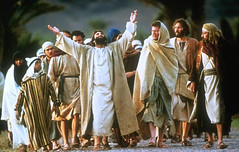
My morning devotional study found me pondering Luke 19:10 how Jesus came to seek and to save that which was lost. I’d been to that verse many times before and could easily quote it by heart. This particular break of day I needed to be reminded of the reason for my existence. The words articulated it so well. It’s all about seeking the lost and training the found. A side note in my Bible titled Jesus as the “Seeking Savior” and sent me fumbling through the pages to a reference in Matthew 9:36:
“But when he saw the multitudes, he was moved with compassion on them, because they fainted, and were scattered abroad, as sheep having no shepherd.”
Image via Wikipedia
The journey in writing this lesson starts in this verse and fuels my trip with the same passion, burden, and vision that gripped my Seeking Savior. He saw the multitudes generally and individual faces specifically. As they scurried about their daily duties, disguised with smiles and happy-go-lucky attitudes, He saw through all of that, to the very heart of the matter. He peered deep into their souls. They were confused, scattered, troubled, tired, distressed, aimless, hurting, helpless, hopeless, perishing, loaded-down, lost sheep needing a shepherd; someone to guide them into the protective fold. The verse closes with sad, convicting words: “having no shepherd.”
He saw: He considered their plight. He had a vision for their destiny. I want to see souls as Jesus sees them. He readily identified the spiritual needs of those He encountered.
He was moved: I want to be moved, stirred, and captivated by the very things that move, stir, and captivate the heart and mind of God.
His heart broke: I want my heart to be broken with the things that break the heart of God. Sounds simple but it is inevitably heart-wrenching.
He was moved with compassion: He felt what they felt. He had a deep awareness of their suffering. He was interconnected with them. He took action to help. His bowels yearned. His compassion was birthed deep within. I want to feel compassion for the lost in two ways: from His point-of-view and from theirs. How long has it been since you put yourself in their place? Imagine the feelings of being lost, hopeless, or drowning. Surely, such compassion will lead to incite, inspire, and invigorate an enthusiastic, whole-hearted, genuine, lively, fiery, deep, passion. It’s okay to get emotional about hurled, hungry humanity.
Note what Jesus said once he saw their state, was moved by the masses, heart-broken at their helplessness, and was compassionate about their calamity. It spoke to His “disciples.” That is a general term used for the twelve that followed Him. But, it is more than that. We are called to make disciples and to be disciples. Disciples are learners. Jesus wanted to teach students something. If you are following the scenario patiently and perceptively you will quickly unveil that the Seeking Savior was endeavoring to give His followers a game plan or a strategy of world evangelism. He has a game plan for winning; winning souls that is. Let’s check it out.
“Then saith he unto his disciples, The harvest truly is plenteous, but the labourers are few” (Matthew 9:37).





 James Poitras